

On the afternoon of March 18, 2026, at the invitation of the School of Foreign Languages, Peking University and the Brazil Cultural Center of Peking University, André Basbaum, President of Empresa Brasil de Comunicação (EBC), delivered a lecture entitled Public Communication Challenges under the Lula Administration in Conference Room 501, New Building of the School of Foreign Languages, Peking University, and exchanged views with the audience on site. The lecture was hosted by Fan Xing, Director of the Brazil Cultural Center of Peking University, with teachers and students majoring in Portuguese language attending the event.
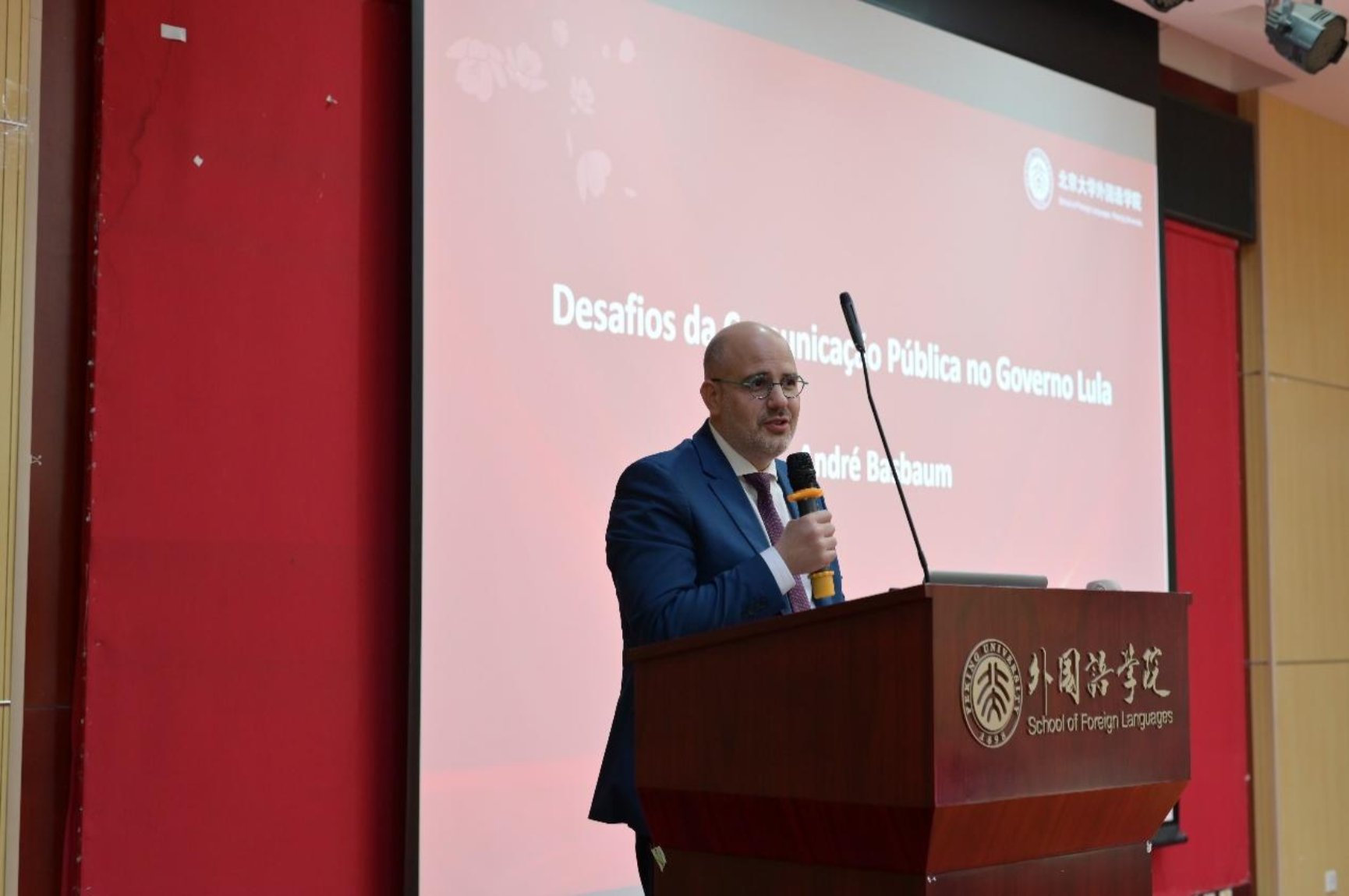
At the beginning of the lecture, Mr. Basbaum pointed out that information is disseminated at an unprecedented speed, and the public is overwhelmed by massive volumes of information on a daily basis. Communication has long transcended professional issues confined to the media sector, evolving into a core capability closely intertwined with social operation, national governance and business development. Accordingly, constructing a public communication system featuring genuine credibility, extensive coverage and practical service capacity has become an unavoidable vital issue for contemporary Brazil.
Focusing on this topic, Mr. Basbaum reviewed the historical evolution of Brazil’s communication system, noting that the sector has long been dominated by a small number of large private media conglomerates, leaving public media restricted in development space across multiple dimensions. Since its establishment in 2007, EBC has consistently faced practical dilemmas including insufficient resources, limited territorial coverage and constrained room for growth. Meanwhile, competition for advertising revenue and public attention driven by digital platforms and major U.S. technology corporations has reshaped the traditional media ecosystem. In his view, against such backdrop, public communication stands at an opportunity to redefine its own value. It shall not merely serve as a supplement to commercial media, but integrate into the daily lives of ordinary citizens and fulfill its public service mandates.

Furthermore, Mr. Basbaum interpreted Brazil’s communication strategy within a broader international landscape, stating that Brazil’s global relations no longer exclusively focus on North America and Europe, but are increasingly oriented towards the Global South with more proactive international narrative. With regard to China-Brazil relations, he repeatedly emphasized the practical foundation and symbolic significance of bilateral friendship, stressing that sustainable international communication should not be confined to media technologies and policy statements, but grounded in cultural exchanges and mutual public understanding. Confronted with dominant external narratives and communication hegemony, political slogans alone are inadequate. In-depth mutual understanding must be fostered through exchanges in culture, art and language.
During the interactive session following the lecture, attendees held in-depth discussions on prospects for China-Brazil bilateral relations, approaches to enhancing public communication appeal, effective outreach to young audiences, proactive utilization of media resources and communication platforms, as well as the prevention of ceding narrative space to others. Against the backdrop of the 2026 China-Brazil Year of Culture, this lecture deepened the understanding of Portuguese language faculty and students at Peking University regarding Brazil’s realistic situation in public communication, and prompted reflections on the profound correlations among media, culture and international cooperation.

Text: Department of European Languages
Photo: Dong Zequan
Translated by Zhou Junxia